
7 Characteristics of High Performing Teams
Research on high performing teams is everywhere. But knowing the characteristics isn't the same as building them. This article covers the seven characteristics that research — and 8,000+ leader reflections — consistently point to.
8,000+ leader reflections collected over five years. Participants span technology, industrial services, healthcare, and non-profit — from ASX-listed companies to 65-person organisations.
Methodology co-developed with Professor Anne Lytle, who spent 30 years teaching leadership at Kellogg, Melbourne Business School, and Monash University (Professor and Director of Leadership). Her research background in neurobiology (Cornell) and organisational behaviour (Kellogg PhD) shaped the science-based approach.
Past-president of the International Association for Conflict Management. Consulted to ANZ, Boeing, Qantas, Telstra, and the United Nations.
Recognised by AACSB's Innovations That Inspire — the global standard-setting body that accredits Harvard, Wharton, INSEAD, and London Business School.
What is a high performing team?
A high performing team consistently exceeds expectations, collaborates effectively under pressure, and maintains trust, accountability, and psychological safety even when things get difficult. The difference isn't talent — it's culture, and culture is shaped by leadership.
Research on high performing teams is everywhere. We know trust matters. We know psychological safety is important. We know communication and accountability play a role.
But knowing the characteristics isn't the same as building them.
This article covers the seven characteristics that research — and our data — consistently point to. For each one, we'll share what the evidence says, what leaders actually experience when they try to build it, and where most get stuck.
The 7 Characteristics of High Performing Teams
- Trust
- Psychological safety
- Clear communication
- Constructive feedback
- Accountability
- Shared goals and purpose
- Resilience and growth mindset
1. Trust
What the research says
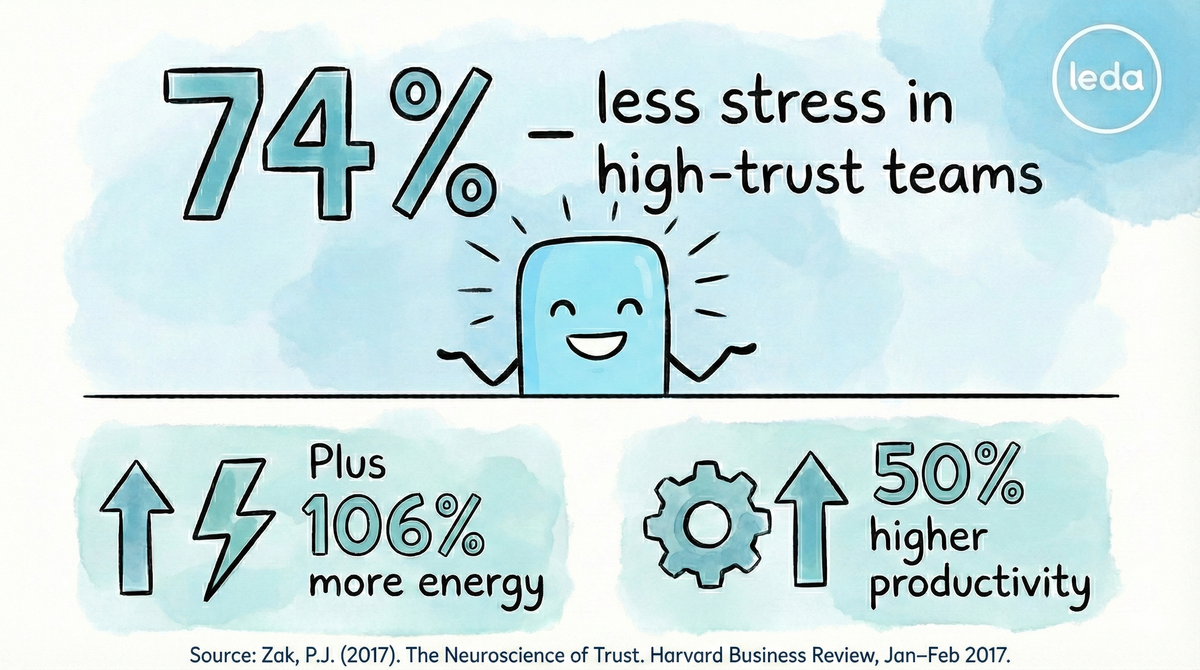
Paul Zak's research on the neuroscience of trust found that people in high-trust companies report 74% less stress, 106% more energy at work, 50% higher productivity, and 76% more engagement than those in low-trust environments. They also experience 40% less burnout and 29% more satisfaction with their lives.
Trust isn't a bonus. It's the foundation everything else is built on.
According to research by Jack Zenger and Joseph Folkman, trust has three elements: positive relationships, good judgement and expertise, and consistency. Building these requires emotional intelligence training—particularly self-awareness and relationship management skills. Miss any one of these and trust erodes.
What leaders experience
When we ask leaders to reflect on trust in their teams, the patterns are consistent. They recognise trust matters, but struggle with how to build it deliberately.
He is always affable, approachable, friendly, and helpful. He will speak up, with courage, when he senses unbalanced fairness or an injustice.
— Leader reflecting on a trusted colleague
What stands out is that trust isn't built through grand gestures. It's built through small, repeated actions: keeping confidences, giving credit, admitting mistakes, following through on commitments.
Where leaders get stuck
Many leaders underestimate how closely they're watched. Team members notice when you take credit for others' work, when you gossip, when you say one thing and do another. The leaders who build trust fastest are the ones who hold themselves to the same standards they expect from their team — visibly and consistently.
2. Psychological Safety
What the research says
Psychological safety is the belief that you won't be punished or humiliated for speaking up with ideas, questions, concerns, or mistakes. Amy Edmondson's research, along with Google's Project Aristotle, identified it as the single most important factor in team effectiveness.
What leaders experience
Leda's curriculum defines psychological safety as a collection of conditions that allow the team to communicate, collaborate, and create without fear — a "Green Brain" state where work is seen as a satisfying group challenge rather than a threat.
Leaders often assume their team feels safe because no one has complained. But silence isn't safety.
There are a few times when there has been a lack of connection within the team that makes it hard to have free flowing conversations.
— Leader in our program
Research shows that diverse teams have the potential to achieve at higher levels than non-diverse teams — but only when psychological safety exists. Without it, the differences that could feed creativity instead cause friction and miscommunication.
The leaders who build psychological safety tend to share a few behaviours: they admit their own mistakes first, they ask questions before making judgements, and they respond to failure as a learning opportunity rather than a reason to assign blame.
Where leaders get stuck
Psychological safety is fragile. One dismissive response to a question, one public criticism, one instance of shooting the messenger — and it takes months to rebuild. Leaders often don't realise they've damaged it until the symptoms appear: disengagement, turnover, or a team that agrees with everything in meetings but resists in practice.
Read our deep dive on psychological safety →
3. Clear Communication
What the research says
Leaders spend up to 80% of their day communicating. Yet poor communication remains one of the main reasons people disengage from work, produce less, and struggle to collaborate. It's also the root cause of most interpersonal conflict.
Most of us think we're good communicators. We know what we mean. But everyone interprets information through their own assumptions and biases. We fill in gaps. We make up stories about intentions. And often, we misunderstand the message entirely.
What leaders experience
Our data shows that communication challenges aren't usually about clarity — they're about listening. Leaders reflect on conversations where they assumed they knew what the other person meant, only to discover they'd missed something critical.
For them it might be about what they are comfortable with and change is not something they embrace easily. Lacks confidence.
— Leader practising perspective-taking
This kind of perspective-taking — understanding how others see a situation differently — is what separates functional communication from genuine connection.
Leda's curriculum distinguishes between two types of conversation: discovery conversations (where the goal is to understand) and delivery conversations (where the goal is to inform). Most leaders default to delivery when discovery would serve them better.
Where leaders get stuck
The biggest barrier to clear communication is the assumption that you already understand. Leaders who actively listen — who put their own agenda aside and focus on the other person's perspective — consistently build stronger teams. But this requires slowing down, which feels inefficient in the moment even when it saves time later.
4. Constructive Feedback
What the research says
Feedback isn't compliments. It's communication about actions or behaviours that affect individual, team, or organisational performance. Research suggests a ratio of three positive interactions for every corrective one creates the conditions for feedback to be heard and acted upon.
The challenge is that feedback often triggers threat responses. David Rock's SCARF model identifies five domains that activate defensiveness: status, certainty, autonomy, relatedness, and fairness. Most feedback, however well-intentioned, threatens at least one of these.
What leaders experience
Easy to give positive feedback, improving on providing constructive criticism.
— Leader in our program
Leaders consistently tell us that giving feedback is one of the hardest parts of their role. Leda's methodology uses the concept of "connection credits" — the positive interactions that build the trust needed for corrective feedback to land. Without enough credits in the bank, even well-delivered feedback triggers defensiveness.
The FECA model (Frame, Evidence, Consequences, Action) gives leaders a structure for delivering feedback that reduces threat responses:
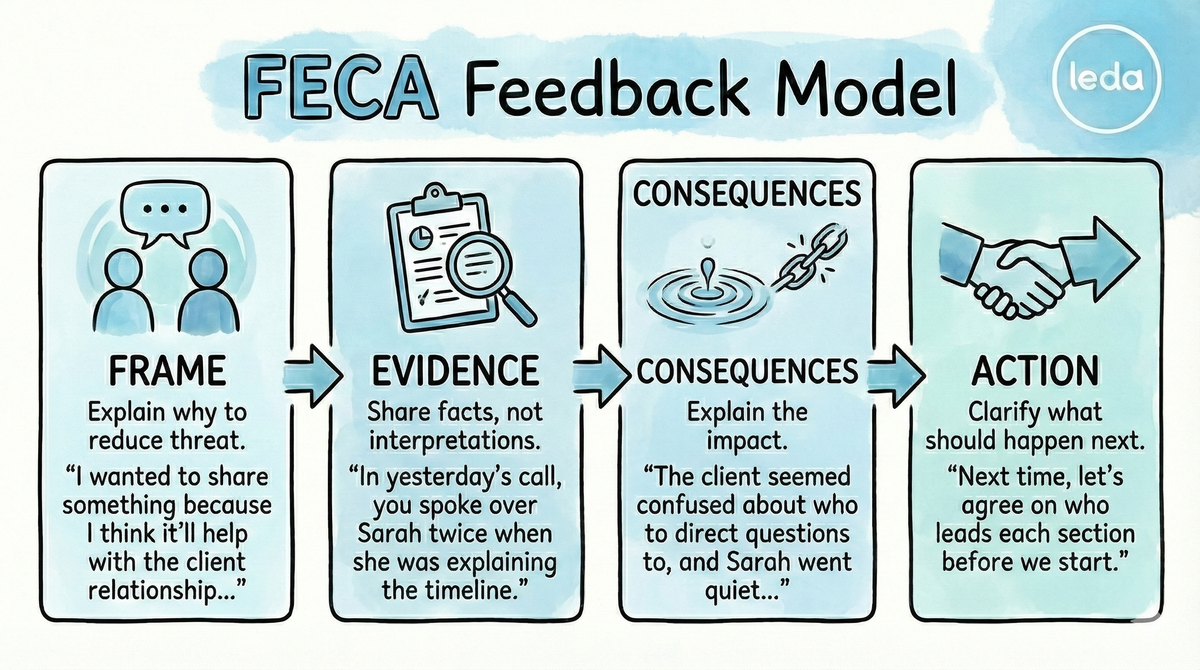
- Frame: Explain why you're giving feedback in a way that reduces social threats
- Evidence: Share non-judgemental observations of behaviour
- Consequences: Explain the impact of the behaviour
- Action: Clarify what should happen next
The leaders who give feedback well tend to build connection credits daily. They notice what's going right, not just what's wrong. They frame feedback as an opportunity for growth rather than a correction. And they deliver it in the moment rather than saving it for formal reviews.
Where leaders get stuck
The skill isn't avoiding difficult conversations. It's having them in a way that strengthens rather than threatens.
5. Accountability
What the research says
Accountability means walking your own talk. It's following through on commitments, showing up on time, delivering on agreed goals. But it's not just about individuals — it's about creating conditions where everyone holds themselves and each other to shared standards.
Research on team culture shows that organisations with strong accountability see 65% greater share-price increases, 26% lower turnover, and 15% higher productivity compared to those with disengaged cultures.
What leaders experience
Leda's accountability framework identifies six requirements for individual accountability to exist:
- They know what's expected — quality, quantity, and nature of their contribution
- They have the skills and capability to deliver
- They've committed to delivering
- They can measure their contributions against standards
- They receive frequent feedback
- They understand the consequences of meeting or missing standards
When any of these is missing, accountability breaks down — and the leader usually gets blamed for the gap.
If I'm not accountable for the output of my team, a lot of other departments fall over and are put under pressure.
— Leader in our program
Where leaders get stuck
Leaders often confuse accountability with blame. They create fear rather than clarity. The best accountability cultures are built by leaders who model it themselves — who own their mistakes publicly, who follow through on their own commitments visibly, and who create systems for tracking progress rather than relying on surveillance.
6. Shared Goals and Purpose
What the research says
Goals motivate. They give direction. They help people understand how their work contributes to something larger. Research on motivation consistently shows that people perform better when they feel they're heading somewhere — when they can see progress and meaning in their work.
But goals alone aren't enough. Alex Liu's research on joy at work found that high-performing teams share a sense of purpose that connects individual work to broader impact. Joy arises from harmony (belonging, empathy, trust), impact (purpose, contribution), and acknowledgement (recognition, being valued).
What leaders experience
Leaders often set goals without connecting them to purpose. One reflected on their team: "Achieve monthly customer survey targets continuously for 3 months." Clear and measurable — but where's the meaning?
The leaders who build alignment go beyond SMART goals. They help team members see how their work matters.
Provides support that positively impacts on teachers' daily working lives.
— Leader connecting work to purpose
The GROW coaching model (Goal, Reality, Options, Will) appears frequently in our data as a framework leaders use to keep goals alive through ongoing conversation rather than setting and forgetting.
Emotional contagion research shows that how leaders feel affects how the team feels. Leaders are watched more closely than peers. When a leader demonstrates genuine belief in the team's purpose, that belief spreads.
Where leaders get stuck
Many leaders set goals once and assume alignment persists. It doesn't. Purpose needs reinforcement. Team members need to be reminded why the work matters — especially when the work is hard. The leaders who maintain alignment revisit goals regularly, celebrate progress visibly, and connect daily tasks to longer-term outcomes.
7. Resilience and Growth Mindset
What the research says
Resilience is the ability to resist, recover from, and adapt to challenges. See our resilience training guide for how we develop this capability in emerging leaders. Carol Dweck's research on mindset shows that people who believe they can learn and improve through effort — a growth mindset — are more resilient than those who believe ability is fixed.
People with a growth mindset see failure as a learning opportunity. Those with a fixed mindset see it as an identity threat. Dweck's research found that praising children for their traits ("you're so smart") creates fear of failure, while praising effort ("you worked hard on that") creates resilience.
Dr Rick Hanson's research on the brain's negativity bias explains why resilience requires deliberate effort: "The brain has teflon for the good and velcro for the bad." We're wired to overlearn from negative experiences. Counteracting this requires conscious practice — research suggests a ratio of three positive emotions to every negative one is the tipping point for flourishing, yet more than 80% of people score below this ratio.
What leaders experience
I actually find I work really well under pressure — while I often feel overwhelmed I just knuckle down and get the job done.
— Leader in our program
The leaders who build resilience — in themselves and their teams — share certain practices. They reframe stress as challenge rather than threat. They reflect on what they can learn from setbacks. They actively cultivate positive emotions to counteract negativity bias.
Leda's Mindshifting framework — developed from research on stress response and emotional regulation — gives leaders a four-step process:

- Catch: Notice the rising stress response — physical sensations, thoughts, behaviours
- Calm: Three deep breaths to signal safety to the amygdala and re-engage the prefrontal cortex
- Choose: Reframe the situation as a challenge or opportunity rather than a threat
- Connect: Share the experience with others to strengthen the learning
The deeper work is developing a growth mindset — seeing failure as learning, not identity threat.
Where leaders get stuck
Research shows that the impact of poor social support on health is similar to obesity, smoking, and physical inactivity. The most resilient leaders model sustainable habits and create space for their team to recover, not just perform.
How These Characteristics Are Built
These seven characteristics share something in common: none of them can be installed in a workshop.
Trust is built through thousands of small, consistent actions. Psychological safety is built by how a leader responds in difficult moments. Communication improves through practice and feedback. Accountability is modelled before it's expected.
The leaders who build high performing teams develop these capabilities over months, not days. They practice daily. They reflect on what's working and what isn't. They receive feedback and adjust.
What this looks like in practice
At MYOB, 264 leaders have completed Leda's Emerging Leaders Program over five years. Fifty percent of the 2020 cohort were promoted. The 2023 cohort achieved a 98% completion rate. Line managers reported participants showing "fantastic willingness to help take responsibilities away from me" — a direct indicator of trust and accountability in action.
At Supagas, more than 150 participants across four years led to a 70% increase in program applications and 10% of the total organisation trained. Their National Learning and Development Manager noted: "I have witnessed a remarkable improvement in our overall team dynamics and collaboration."
At Camp Quality, 21 team leaders completed the program. Thirty percent were promoted. The organisation's engagement score increased from 84% to 89%.
Read the Camp Quality case study →
High performing teams are the outcome. Developing the leaders who build them is the work.
About the author
Ashley Leach is Founder of Leda. Leda's leadership development methodology was co-developed with Professor Anne Lytle (Monash Business School, Kellogg PhD) and has been recognised by AACSB's Innovations That Inspire. The platform has supported thousands of emerging leaders across Australia and New Zealand, with completion rates of 88-98% — compared to 3-15% for typical digital learning.
Frequently Asked Questions
A team is a group of people working together. A high performing team consistently exceeds expectations, collaborates effectively under pressure, and maintains trust, accountability, and psychological safety even when things get difficult. The difference isn't talent — it's culture, and culture is shaped by leadership.
Not directly. You can train individuals to develop the skills that build high performing teams — communication, feedback, emotional intelligence, resilience. But team performance is an outcome of how leaders shape the environment over time. One-day workshops don't create lasting change; sustained development does.
There's no fixed timeline, but meaningful culture change typically takes 6-12 months of consistent effort. Research shows spaced learning significantly outperforms intensive workshops — effect sizes improve from 0.71 to 0.88 when learning is spread out rather than compressed. That's why short-term interventions rarely stick.
The leader is the single biggest influence on team culture. How they respond to failure, how they give feedback, how they model accountability — all of this shapes how the team operates. Emotional contagion research shows that leader mood literally infects the team. High performing teams start with leaders who've developed the capabilities to build them.